This walk was around the grounds of the Purana Qila, the 6th City of Delhi. This fort was built on an existing city, and excavations have unearthed "painted grey ware" that dates to 1000 B.C. Work on the fort itself began with Emperor Humayun around 1533. By 1540, Humayun was forced to abandon Purana Qila after defeat by Sher Shah Suri, the first Afghan emperor of India. Shar Shah Suri added a few structures to the complex during his five-year reign until his death in 1545. The fort saw a few more rapid transfers of power due to deaths and relocations but 15 years after he had abandoned it, Humayun returned to Delhi and re-captured the fort in 1555, again taking control of India. It is clear that each of these rulers contributed to the buildings in Purana Qila, but given the rather quick turnover of power in that time, it is unclear who was responsible for which parts. Humayun's reign was once again brief, as he died the following year after falling down stairs in his observatory.
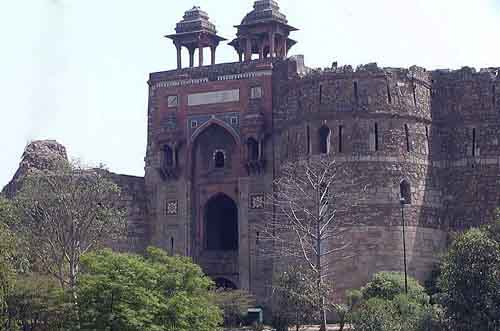

The walls of the fort are about 60 feet tall in places, and they cover about a mile with three arched gateways allowing access to the grounds. The mosque on the grounds of the Purana Qila, the Qila-i-Mosque, was built by Sher Shah in 1541 and is built of brick and red sandstone decorated with red and white marble as well as slate and blue tile.


 For a street food walk I really didn't take that many pictures of the food! We also tasted some sesame seed snacks called Chikki that were sort of like a sesame seed brittle made with Jaggery (a combination of date, cane and palm sugars without separating the molasses) and a traditional indian nut candy, Kaju Barfi (yup, barfi!) which was surprisingly good given the name. Then there was the potato, chickpea, ginger and pomegranate snack that was delicious but I can't find the name of, and some paratha and curries that was way too spicy for me to take more than one small taste. By the end of the tour I was so stuffed I actually skipped the last two dishes, so maybe I will have to venture back to fill in some gaps later, and maybe that time I will remember to take more pictures of the food!


This octagonal tower was Humayun's library and observatory, one of the first observatories built in India. This is also the spot where, in 1556 Humayun fell down the stairs after star gazing and died two days later from his injuries.
After our walk around Purana Qila, we ended up at the New Delhi Crafts Museum, a place I intent to return to spend much more time exploring. These figures were all around the courtyard of the museum.
Humayun's Tomb
Yup, the same Humayun who fell to his death at Purana Qila has his very own UNESCO World Heritage Site! After his death, his first wife built him a garden- tomb, the first one on the Indian Subcontinent. Work began in 1565 and completed in 1572 at a cost of 1.5 million rupees at the time. The gardens are huge, spread over 30 acres surrounding the monument, and they were meticulously planned. The garden is called a Char Bagh Garden (Four Gardens), a Persian-style garden that is completely symmetrical. It is divided into four squares by paved walkways and two bisecting waterways, which represent the four rivers that flow in jannat (Islamic Paradise). Each of the four squares is further divided into four smaller squares with pathways. The waterways appear to disappear beneath the tomb structure and reappear on the other side, an element that was inspired by a passage from the Quran that talks of rivers flowing beneath the Garden of Paradise. The effect is stunning. This is the same kind of garden- tomb as the Taj Mahal, which was built about 50 years later.
Usually you find a mosque alongside royal tombs and in Char Bagh Gardens, but there isn't one in the main enclosure. The only other structure is a much more modest tomb, and it is widely disputed who that tomb is actually for. One account is that it was for the Emperor's barber, another was that it was his step brother, but no one is certain.
The structure is made of red sandstone and marble, and it is the first Persian double dome to have been built in India (the same kind of structure as the Taj Mahal). The white marble dome is stunning, but no more so than the amazing building itself which is a mix of red and yellow sandstone, with white and black marble detailing. Apparently up until May of this year there was a 20 ft high brass finial on top of the crescent dome, but it was hit by lightning and destroyed. In my pictures you can see just a tiny bit of scaffolding at the top of the dome where they have been doing some repairs.
Detail work along the front of the building.
Stairs up into the main courtyard, and an impromptu photo shoot!
This group of school girls were visiting while we were there and seemed to be enjoying themselves very much!
The view from the gardens.
See, I was there!
Just outside the main compound is this tomb and mosque of Isa Khan who was a noble in the court of Sher Shah Suri. This is an octagonal tomb, in an octagonal garden... they sure liked geometry! This predates Humayun's tomb by about 20 years.
Chandi Chawk street food tour.
Our last walk before the Christmas holidays was to old Delhi, or Chandi Chawk, for an introduction to traditional street foods. See how brave I am getting!
First up is one of the strangest things I have ever eaten Daulat Ki Chaat. I had read about this dish, and it has a sort of mystical reputation. It is only made in the winter, when the nights and mornings are cold, and it is only made by the street vendors. You will never find this in a restaurant or sweet shop anywhere. It is made by whipping milk by hand all night. As the milk is whipped, the foam is scraped off and piled high in a large pan, which is then allowed to set up in the "dew of the new morning." There is a sweet crumb mixture that this fellow puts into a small tin bowl along with the milk froth stuff, and then it is all sprinkled with some sugar, and a few pistachios. Most people who I found writing about this dish said something like "the soft, fluffy creamy texture vanishes like a cloud or a dream on your tongue" which sounds good right? One local food blogger I really like even called it "God's own street food." I am not saying it was horrible or anything, and I am glad that I tried it, but I don't really see myself seeking out that experience again. It was sort of meringue- like, less creamy than whipped cream, and really just odd.
This dish was followed by a few samosas of different kinds, no pictures of those, you all know what they look like!
Then there was this dish, Khoya. Basically they start with milk in this iron pan over a fire, and cook it until the milk solids can be scraped to the top of the pan. They keep cooking it until only the milk solids remain, and then scoop them into little bowls. It tastes sort of like ricotta cheese, a bit grainy, and a bit creamy. It wasn't offensive in any way, and in fact some of the people on the tour really loved it, but I wasn't one of them.
Old Delhi is basically made up of a system of "streets" like this one where it is very easy to get turned around an lost.
Am I blending in?
We stopped for some hot Chai (it was a rather cold day!) and this gentleman in the fancy green Dolce and Gabanna sweatshirt wasn't really all that thrilled to be making Chai for us. I think our tour guide insulted him in some way as there was quite a bit of back and forth in Hindi that didn't seem all that pleasant before he started the tea. I wasn't really all that thrilled to be drinking Chai that was made in that pot, by a person who obviously wasn't excited about making it for me, but it was cold and the Chai was warm so what the heck.

No comments:
Post a Comment